
Recognising and exploiting optimisation potential
Automating manual processes requires highly flexible software solutions
The demands on EMS providers are rising continuously. This constantly drives efforts to optimise processes. Higher product quality, greater process stability and savings in production time are decisive factors. A medium-sized electronics service provider has opted for a complete solution that accompanies the entire process and, in addition to automating optical inspections, helps to uncover potential for process optimisation.
published in EPP 11/2013
With comprehensive technological know-how, ELOTEC Fischer Elektronik GmbH (ELOTEC for short) offers customer-specific production of electronic products. At its site in Furth im Wald, the medium-sized service provider produces electronic assemblies and complete devices for more than 80 industrial customers. The ISO 9001:2008 certified company attaches great importance to the high quality and reliability of the products it manufactures and works continuously to improve its production processes.
First article inspection – done quickly
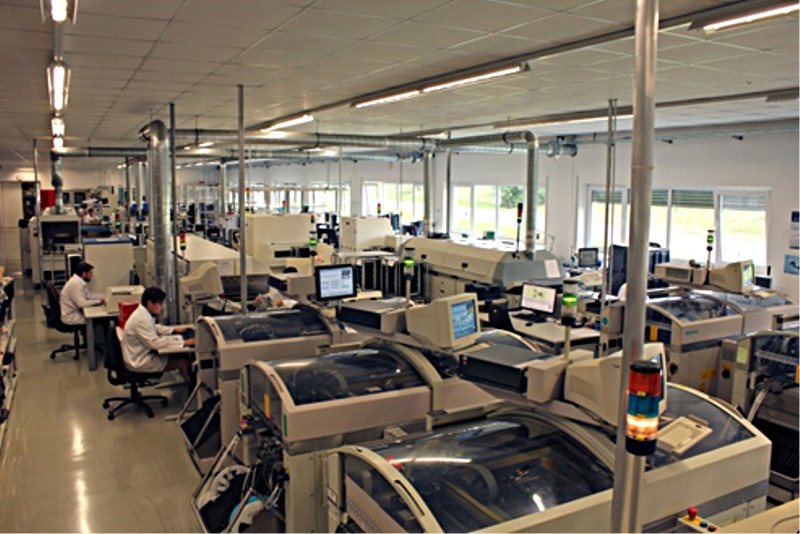
For this reason, ELOTEC was looking for effective support for first article inspection in 2011. With 10 to 15 genuine new product starts a month, a complete manual check of the first PCB produced took a great deal of time. Depending on the number of components, manual inspection using a microscope, a printed placement list and an assembly plan took as much as 3 to 4 hours. During this time, the line stood still. For small batches of 10 to 15 boards, this waiting time was usually not worthwhile, and production continued in parallel with the first article inspection. If an error was then discovered, the batch had often already been produced and costly rework was required.
To improve the process, the main focus was therefore placed on speeding up first article inspection. ELOTEC evaluated several systems and in August 2011 opted for EFA Inspection from LEBERT Software Engineering (LSE for short).
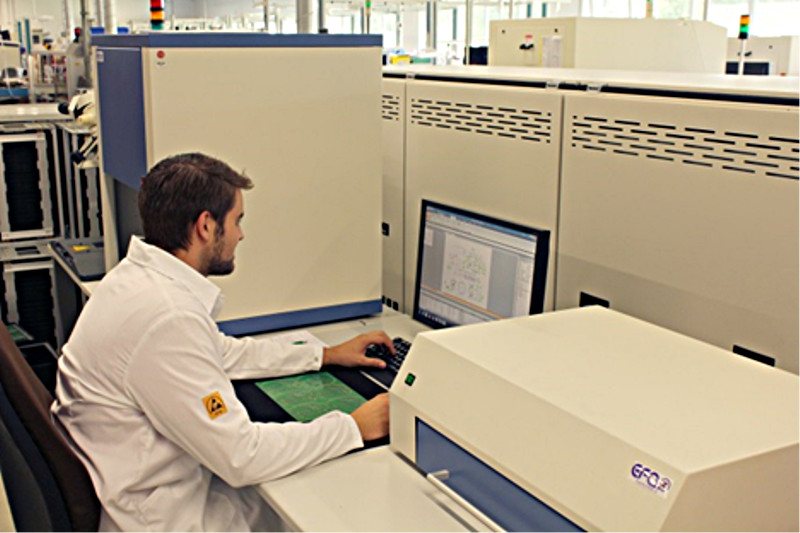
This semi-AOI solution makes it possible to automate manual inspection processes without lengthy programming. An EFA program is set up within a few minutes, making all information (e.g. assembly plan, coordinates, article number, component designation, values etc.) quickly and easily available to the operator. All information is displayed centrally to the inspector, so that component orientation, values and presence can be checked precisely. EFA Inspection ensures that every component is looked at and assessed.
By using EFA Inspection, ELOTEC was able to reduce the time for first article inspection from 3–4 hours to half an hour – including setting up the program. Line downtime during inspection was thus reduced by 85%. As a result, first article inspection is now also worthwhile for small batches of 10 to 15 boards. In addition to the greater quality assurance gained, the time spent reworking entire small batches has been almost completely eliminated.
Process reliability through spot checks
After optical inspection of first articles had been successfully improved, ELOTEC began to optimise the manual spot checks at the line. For process monitoring, EFA Inspection was used together with the EFA Picture imaging station during the production of larger series. The main focus was on regularly monitoring the process quality of ongoing production and thus detecting errors at an early stage. The faster deviations are detected, the faster it is possible to respond. This is where the golden board function of EFA Inspection comes in. The image is automatically integrated into the program already created for the first article inspection and displayed alternately with a golden board. The guided inspection then shows the image section by section. Errors are immediately recognisable because of the movement in the image.
At this process step, too, using EFA Inspection saves valuable process time. In addition, process reliability has been increased significantly and the rework effort noticeably reduced. Mr Berzl, who is responsible for process control at ELOTEC, reports that EFA Inspection is intuitive and easy to use.
“We were also able to train people who do not normally carry out optical inspections. This means every shift can easily monitor its own process steps,” says Mr Berzl.
Zero-defect production in THT
In the next step, the potential use of EFA Inspection in THT was explored. At ELOTEC, conventional assembly is carried out manually for batch sizes of 1–150 boards. After assembly, the boards are visually inspected. Due to fatigue, errors kept occurring in manual production, which also led to complaints.
Initial tests with EFA Inspection showed that a stable image comparison between the golden board and the board under test can also be set up for THT assembly. Thanks to fiducial alignment in EFA Inspection, the board images are positioned so stably relative to each other that only the movement of components is visible. The camera-based imaging solution can also photograph boards with tall components in a very short time. The individually adjustable lighting ensures homogeneous illumination of the boards.
Following the successful tests, every conventionally assembled board is now checked with EFA Inspection. This has drastically reduced the number of complaints.
“There are virtually no more complaints,” explains Mr Berzl of ELOTEC.
As a welcome side effect of the automatically generated documentation of the board images, even unjustified complaints can be reliably fended off.
Use beyond optical inspection
Recently, ELOTEC has turned its attention to the particular requirements of assembly variants. For visualisation, fitted and unfitted components are shown in the assembly plans with different colour markings. Until now, creating these assembly plans was a time-consuming manual process. If changes had to be made, the marking process started all over again. Visualisation is now carried out with the work preparation module of EFA Inspection. Among many other functions, this software extension makes it possible to mark the components of the assembly plan in different colours. These variant-specific assembly plans are created more or less as a by-product, since EFA Inspection is used for first article inspection anyway. Changed assembly variants or subsequent adjustments can be entered with just a few settings. In this area of application, too, EFA Inspection provides a time-efficient and reliable solution.
Originally purchased to support first article inspection, EFA Inspection has since developed into a tool that can be used throughout production. Not only has manual inspection been automated in a targeted way; the information that EFA Inspection provides on the individual production steps also reveals optimisation potential. This can be used specifically to eliminate weak points in the process. Using the feedback from EFA Inspection, ELOTEC has achieved additional stability in production through training and changes to its procedures. This directly increases the quality of the products manufactured and ultimately the company's competitiveness.