
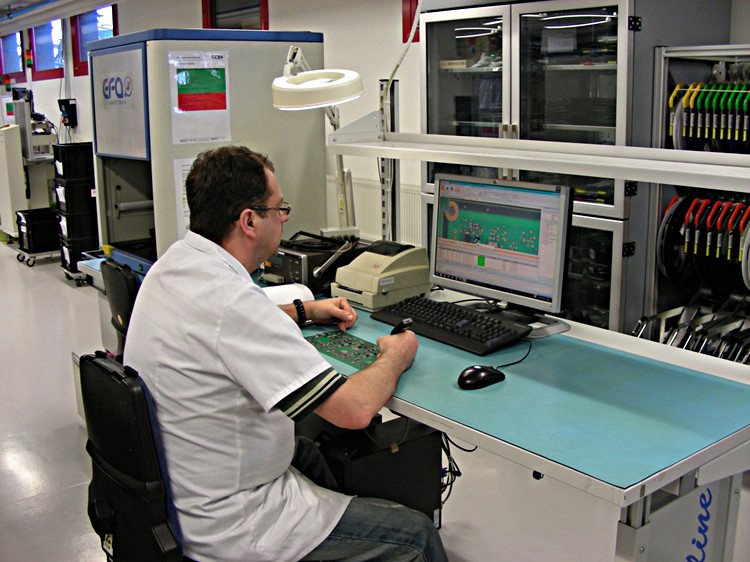
Significant time savings achieved
Focus on automating manual optical inspections
During the manufacture of electronic assemblies, product quality is ensured by a large number of inspections. The aim is to detect deviations in the process as early as possible. This is the only way to avoid high costs for rework, “series defects” or even complaints. Inspections at the start of the production process in particular are carried out optically. Many of these optical inspections are the responsibility of visual inspectors who assess the assemblies manually. CCS Schweiz AG uses the EFA Inspection system, which provides targeted support for its visual inspectors and thus ensures process reliability and time savings.
published in Productronic 5/2014
As part of CCS Customer Care & Solutions Holding AG, CCS Schweiz AG is a leading electronic design & manufacturing services partner. With sites in Switzerland, Germany, China, Hong Kong and Sri Lanka, CCS offers an optimal production structure for its customers' wide-ranging requirements. The Swiss site in Lyss has 2,000 m² of production space with “state-of-the-art” machinery. The location of the site guarantees proximity to customers and thus quick and uncomplicated communication during development and production. Dedicated customer teams are available for customer-specific projects – including the production of prototypes, pilot runs and pre-series.
At the beginning of 2011, CCS Schweiz AG was looking for effective support for first article inspection. The aim of this inspection is to reliably detect deviations in the placement before series production starts. Until then, first article inspection had been carried out manually: working from the component list, each component was searched for on the board, compared and assessed one by one. Depending on the number of components on the board, such a first article inspection sometimes took several hours.
This process makes use of the visual inspectors' wealth of experience, but because it is manual it is extremely error-prone. Small distractions or fatigue can lead to errors being overlooked. Afterwards, there remains the uncertainty as to whether all components have really been assessed correctly. Beyond the lack of traceability and logging, it is above all the large amount of time spent searching for components on the board that has a negative impact on the process. During the time-consuming manual inspection, the fully set-up line waits for production release. This costs a great deal of valuable process time.
Automating manual optical inspection
CCS Schweiz AG evaluated several systems and, after a short test phase, opted for the EFA Inspection solution from LEBERT Software Engineering in June 2011.
“The first thing that impressed us was how easy it is to use,” explains Mr Lempen of the Production Engineering, Test & Final Assembly department.
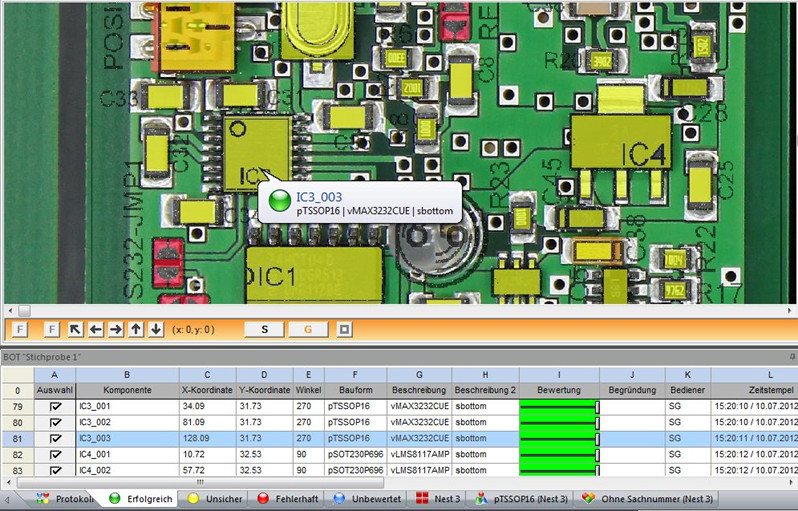
Creating programs in EFA Inspection could hardly be easier. The data can be used exactly as it is already available for the production machines. The programming itself takes less than 5 minutes. During programming, the placement data (coordinates, article number, component designation, values etc.), the assembly plan and an image of the first board are integrated. All this information is then available in one place. The inspector is guided through the inspection. One after another, all components are displayed together with the available information from the assembly plan and the component list. (see screenshot 1)
“This guided inspection gives us the certainty that the inspector has looked at and assessed every component. No element can be forgotten,” says Mr Lempen, emphasising this function.
The assessment is made by the operator and thus makes use of the extensive experience and flexibility of the visual inspectors.
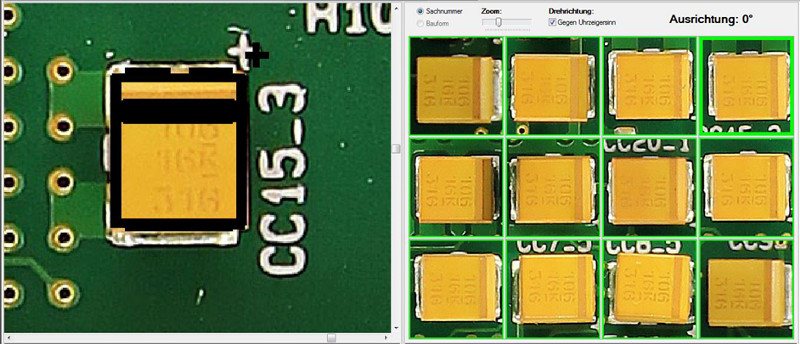
In addition to the usual first article inspection procedure, in which one component after another is examined, EFA Inspection can also inspect by part number. All components are sorted by part number, and components with the same part number are displayed side by side. In the display, the components are then rotated back to zero degrees according to the stored rotation angle. One of the components is checked in detail in the main window, e.g. by overlaying it with the schematic drawing. For the remaining components with the same part number, a comparison with the component checked in detail is then sufficient. This makes it possible to inspect the presence and orientation of all components with the same part number very quickly. Inspecting part number by part number saves considerably more time than checking each component individually. (see screenshot 2)
With a total of 7 different inspection types and many individual settings, EFA Inspection can be integrated optimally into established procedures. The program itself is therefore versatile and can be adapted flexibly.
“There are hardly any limits to the possibilities of integration into the existing production landscape,” emphasises Mr Lebert, Managing Director of LEBERT Software Engineering. “In addition, EFA Inspection is continuously being developed further. We also implement individual adaptations in data integration, connection to existing MES systems or even extensions to the software's functionality very promptly.”
Once the inspection is complete, an inspection report can be generated. Alternatively, the results can also be transferred to the existing MES system.
Process reliability gained
By introducing the system, CCS Schweiz AG was able to cut first article inspection times drastically. With up to 2,500 components on a board, the time savings are well over 50% – many customers even report time savings of up to 80%. This has a direct impact on the overall lead time of a product. Not only can more be produced; the process itself has also become much more reliable.
“With EFA Inspection, we have achieved significant time savings together with a marked increase in quality and process reliability,” says Mr Lempen, describing the successful use of the system.
In addition to first article inspection, the EFA Inspection system also offers ways of automating optical inspections for small batches, prototypes and setup checks. With a wide range of functions and options such as measurement, the panel function, fiducial recognition, the golden board function, automatic loading and automatic export of results, the manual optical inspection process can be automated exactly as the existing process requires.