
The optimal optical inspection solution
EMS provider from Nordhausen relies on an innovative semi-AOI solution
Automating optical inspection for small and medium batch sizes is a challenge for EMS providers. Manual inspection processes are time-consuming, error-prone and offer little reliability. AOI solutions cannot be used sensibly for the optical inspection of small and medium series. Semi-AOI solutions, on the other hand, offer time savings and inspection reliability.
published in Productronic 09/2013
True to its philosophy “Special tasks require special solutions!”, Hörmann IMG GmbH offers innovative products with customer-oriented solutions. As part of the Hörmann group of companies, the Nordhausen-based company specialises in high-quality electronic systems, innovative vehicle drive technology such as hybrid and electric drive systems, energy technology in the field of renewable energies, and EMC and materials testing services. Close cooperation with universities and scientific and research institutions ensures future-oriented services and products of high quality and reliability.
This orientation as an E²MS provider results in a broad product spectrum with high expectations of flexibility in production. Frequent product changes, small quantities and high component density also place high demands on optical inspection.
Until then, visual inspection had been carried out purely manually using a VS8 vision system. Presence and polarity were checked using the four-eyes principle. With this method, the first article inspection of assemblies can sometimes take 8–10 hours with 2 workers, depending on the number and density of components. Checking component by component required a high level of concentration – including on the inspection sequence itself. Working with the microscope for long periods and constantly refocusing put a heavy strain on the eyes, and working continuously for more than 4 hours is impossible. Spot checks also often left the uneasy feeling that an area might not have been checked.
In order to secure its high quality standards for the future in the face of ever-increasing requirements, Hörmann looked for a solution to support optical inspection in 2012. The aim was to eliminate the disadvantages of manual inspection and to speed up the process considerably.
An AOI system was initially favoured as a possible solution. During the presentations and reference visits, however, it very quickly became apparent that the AOI approach could not be applied profitably to the requirements of small and medium series. The high programming effort and the number of false calls that have to be reworked manually do not speed up the inspection process. This results in very high programming and one-off costs that cannot be passed on to small quantities of assemblies to be inspected. In addition, AOI programming and operation would have required at least one qualified specialist, tying up additional resources. It was therefore clear that a different inspection method had to be found.
Small and medium quantities demand flexible optical inspection
Hörmann then evaluated several semi-AOI systems and in October 2012 opted for the EFA Inspection solution from LEBERT Software Engineering (LSE for short).
“With its camera system, the system is technically more advanced than comparable solutions, it is user-friendly and it offers a wide range of applications,” says Mr Linde, authorised signatory and Head of Electronic Systems at Hörmann.
The future-oriented nature of the solution was also convincing.
“It is important to us to keep integrating customer requirements into the existing software. That is the only way to create a practical system that can be used in many different ways!” says Mr Lebert, Managing Director of LSE, underlining this aspect.
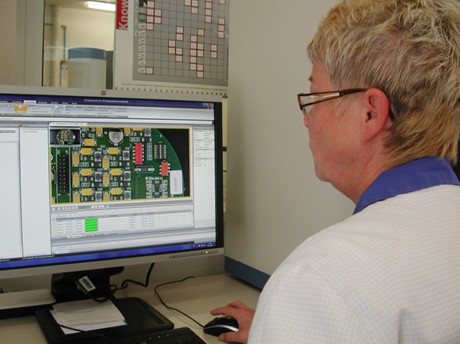
EFA Inspection automates the inspection process and displays all the information required on a single image layer. Under these conditions, the operator can make an assessment quickly and reliably. Programming the system takes only a few minutes. It can work with coordinate and BoM information, or alternatively “just” set up a golden board comparison. The inspection decision criteria and the segmentation of the image comparison can be specified individually. With 7 different inspection types, EFA Inspection offers enough flexibility to adapt to different inspection scenarios.
Positive effects were noticeable shortly after EFA Inspection was introduced.
“The time spent on optical inspection plummeted,” says Mr Linde, describing the first results of using EFA Inspection.
Instead of an inspection time of 8–10 hours with 2 people, a single person with EFA Inspection now needs only 1–1.5 hours for a first article inspection. This means pure time savings of 80–90% and staff savings of 50%!
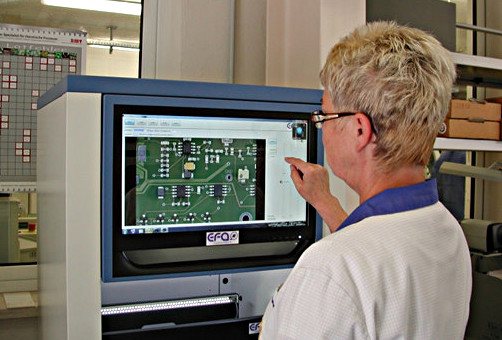
The inspection itself is carried out using an image of the board. The high-quality images are created quickly and easily with the EFA Picture Touch unit.
“Our wide range of components, packages and assemblies can be covered by the camera system in good resolution,” says Mr Linde about the image quality.
The optimum lighting can be adjusted individually for each board via the touch screen computer. For boards with particularly large dimensions, an HR version of the EFA Picture Touch units is also available. It captures several partial images per board, which are then stitched together into a full image.
The focus of the 2D optical inspection is on checking the presence and polarity of the components. By changing the colour settings, Hörmann has also been able to achieve a 3D effect that makes it possible to assess solder joints on screen.
A gain for the entire process
Mr Linde reports that the significant change in the optical inspection process has had an impact on the entire production throughput process. By interlinking the production steps more closely, Hörmann was able to optimise its throughput concept. In addition, EFA Inspection provides traceability of the assemblies more or less as a by-product.
Optical inspection has also improved greatly for the operator. A single viewing layer, all information in one place and 100% certainty of having inspected all components or segments of the board support the inspector effectively. This allows longer and more focused inspection.
As an EMS provider, Hörmann has also been able to include the optical inspection of PCBs in its range of services. The use of the semi-AOI solution guarantees a low probability of errors.
This makes “EFA Inspection indispensable as a selling point for EMS providers in the small and medium quantity segment,” says Mr Linde, underlining the all-round positive aspects.
EFA Inspection is part of EFA SmartSuite, a complete solution from LSE that accompanies the entire process, supporting all of production from work preparation to final inspection with applications developed specifically for this purpose. EFA SmartSuite is a “living” system that has grown directly out of many and varied customer requests and is regularly extended with new solutions.