

EMS – more than just electronics manufacturing!
Industry 4.0 requires smart solution concepts.
Electronics manufacturing is changing! Fast quotations, complex work preparation and short delivery times for ever smaller batches pose new challenges for the organisation of quotation management, work preparation and production. With the “EFA SmartSuite” software solution, Fercad Elektronik from Wiehl has significantly optimised its processes and introduced augmented reality inspection along the way.
published as the cover story in Productronic 03/2017
The demands on EMS providers are high! With customer satisfaction as the goal, customer ideas are to be implemented with great flexibility, cost-effectively, as quickly as possible and in the highest quality, starting from a batch size of 1. However, a considerable amount of time is already spent before an order is placed. Quotation management has to process the customer data in such a way that a competitive quotation can be prepared. If no order follows, this investment of time is wasted. If an order is placed, work preparation has to prepare and verify the data for efficient use in production. The smaller the production batch, the greater the impact of this effort.
With tightly calculated prices and schedules, there is no room for errors – and this does not just mean placement errors. An error in the data, a faulty process step or a missing piece of information can drastically reduce the profit margin.
Challenges in practice
The key to an efficient process in the run-up to production lies in handling the non-standardised customer data. Processing this data begins even before the actual order. When preparing a quotation, the customer's component details are assigned to the part numbers in the company's own material database to determine the price. Because different notations and units are used, searching the company's own material database is often time-consuming. If no order is placed, the time invested here is wasted.
When an order does come in, the real work begins for work preparation. The updated BoM file usually has to be matched against the company's own material database again. The data also has to be examined for changes, checked for correctness and prepared for production. Different applications are often used for these steps, above all Excel. However, the editing options for the special requirements of summary BoMs are often limited, and as a last resort entire lists are sometimes even copied out by hand. This process is therefore not only time-consuming but also error-prone.
Production uses the prepared data. Immediately after the first article has been produced, the placement is checked against the BoM and the assembly plan. If this inspection is carried out against the processed data rather than the customer data, any errors made during preparation remain undetected. In addition, first article inspection, which is mostly manual, is a very time-consuming and error-prone process. Meanwhile, the fully set-up line waits for the “go” before production can begin.
EMS provider Fercad Elektronik
To further increase the quality of its products and reduce line downtime, Fercad Elektronik GmbH from Wiehl was looking for a suitable application.
The family-owned company was founded in 1990 and has grown steadily ever since. It moved into its new headquarters in 2012, which were extended as early as 2014. The new hall has been in operation since 2015. Fercad serves customers from a variety of sectors, including medical technology, automotive, industrial electronics, aviation and measurement and control technology.
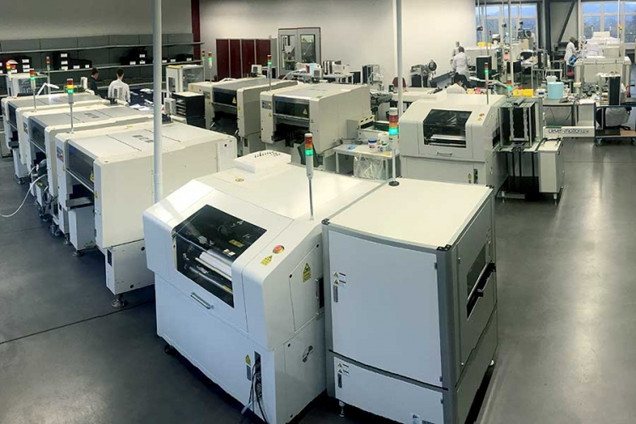
True to the motto “Electronics manufacturing to perfection”, regular investment in modern machinery and new technologies safeguards competitiveness and high production quality (Figure 1).
In its search for support for optical inspection, Fercad found what it was looking for at Lebert Software Engineering. However, everyone involved quickly realised that far more extensive optimisations could be achieved with the EFA SmartSuite system.
Fast quotations
In the quotation phase, the EFA Supply and EFA ERP applications support fast quotation preparation. Only the customer's BoM is used as the basis. The format and structure of this list are almost irrelevant for importing. Directly from the imported customer BoM, EFA uses fuzzy search algorithms to find the right part numbers in the connected material database. To do this, EFA interprets the values given and suggests possible matches from the material database. The order of the individual details within the component description plays no role, nor do the notation or units of the respective values. This automated search can achieve significant time savings.
“Thanks to the link with our component database, we can create BoMs much faster. We can save at least 50% of the time at this step,” was Fercad's initial conclusion.
Efficient work preparation
The EFA Processing work preparation application is designed for the non-standardised nature of customer data. As the central hub, the system manages all available information, such as the BoM, the pick-and-place file and the associated assembly plans. The data is linked together and can thus also be checked against each other very easily. If the customer sends an updated BoM file with changes that may not be documented, these are detected automatically and added to the existing data. Differences are highlighted in colour, and necessary adjustments, such as a different part number, are pointed out.
“Placement changes can now be integrated into the current assembly data more easily,” explains Mr Libera from Work Preparation at Fercad.
The option of adding orientation information and text to the assembly plan and the extensive export options for the production machines round off the work preparation functions.
“Our processes are now significantly faster,” says Mr Libera, summing up the benefits of the application for work preparation.
Augmented reality inspection reduces line downtime
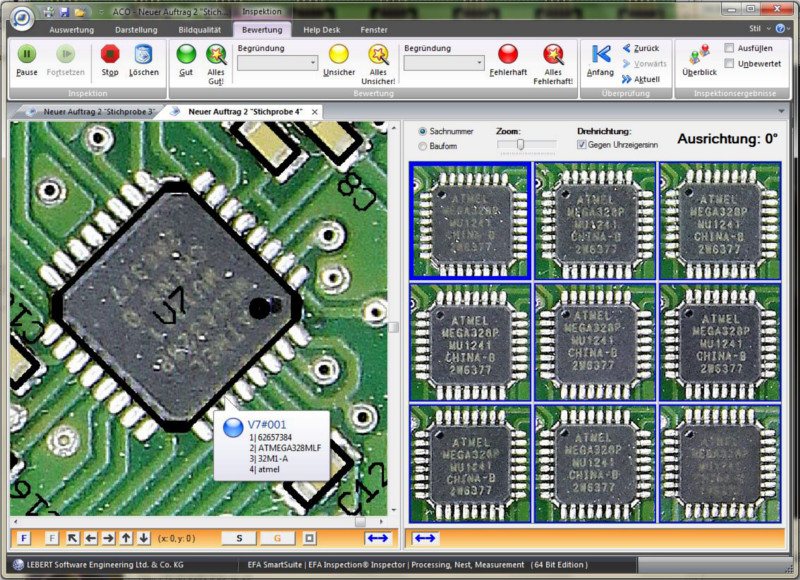
The EFA projects set up in work preparation can be used seamlessly in production. If an image of the first assembled PCB is added, a first article inspection can be carried out. EFA Inspection supports this process with automation. For example, all components with the same part number can be displayed and assessed together. The image sections are rotated back to zero degrees according to the rotation angle from the placement data (Figure 2). The inspector only has to check that all the components displayed have the same orientation. Very much in the spirit of Industry 4.0, the inspection is also enriched with data and information. With augmented reality, the operator always has all the information required in view and can make a well-founded inspection decision without time-consuming programming.
“As we insist on an initial inspection before SMD soldering, we now also use the EFA inspection system specifically at that point, so that consequential errors can be ruled out in advance. In addition, this type of inspection reduces the downtime of our production lines,” says Managing Director Waltraud Aumüller, summing up the benefits.
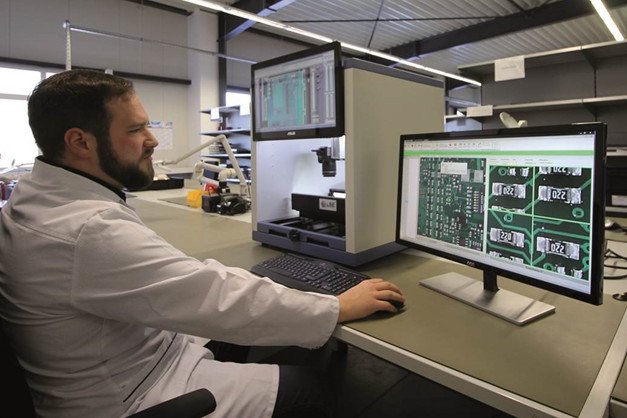
Fercad has also opted for the EFA Picture Touch unit. The camera-based imaging system produces high-resolution images in which “even small components are still clearly recognisable”. The extensive lighting options ensure that even laser-etched markings are recognisable in the image. In addition to the image quality, Fercad was also impressed by the handling.
“Compared with a scanner-based system, the EFA unit saves time when setting up and capturing images.”
Thanks to its user-friendly concept, the EFA Picture unit went into productive operation on the very first day after delivery and training (Figure 3). With EFA Inspection, Fercad now achieves time savings of 70–80% in first article inspection.
A smart solution found
“The search started with a system for placement inspection to further increase the quality of production and thus of the products.” By using EFA SmartSuite throughout, Fercad has achieved more than just this goal.
“The work preparation functions won us over. Our processes have been noticeably optimised as a result.”
EFA SmartSuite is designed as a complete solution that can be used in a targeted way at various production steps (Figure 4). As the central control hub, the system ensures a uniform database that can provide every production step with the information it needs. Smart automatic functions support close cooperation with the user and automate production steps that were previously purely manual. Combining the strengths of people and machines in this way increases efficiency significantly. The software solution is complemented by the EFA Picture Touch imaging systems for use as desktop or inline units (Figure 5).
In the continuous further development of its software, LEBERT Software Engineering relies on close cooperation with its users. Their experience and ideas are regularly incorporated into the software.
“We put people at the centre of our software development,” says Hans Jörg Lebert, Managing Director of Lebert Software Engineering, describing the proven concept.
The result is a practical application “by customers for customers”, in which every customer can find their individual solutions in personalised workflows.